
Life Processes Class 10 — Important Points Visual Revision
Life Processes Class 10: Important Points, Visual Revision Map & Common Mistakes
A fast revision companion for students who have already studied the chapter: core points, visual process maps, comparison tables, common mistakes, board-ready wording and a short self-check.
Life Processes Visual Revision Map
Life processes are the essential activities that keep an organism alive. In this chapter, connect every detail to four questions: How does the organism obtain material and energy? How is energy released? How are materials moved? How are wastes removed?
1. Nutrition
Obtaining food and using it for energy, growth, repair and maintenance.
2. Respiration
Breaking down food to release usable energy for cellular activities.
3. Transportation
Moving oxygen, food, water, minerals and wastes to where they are needed.
4. Excretion
Removing metabolic wastes so they do not accumulate to harmful levels.
1. Nutrition — Important Points
Nutrition is the process by which organisms obtain and utilise nutrients needed for energy, growth, repair and maintenance.
Autotrophic nutrition
Green plants prepare carbohydrates from carbon dioxide and water using light energy captured by chlorophyll.
in the presence of sunlight and chlorophyll
Heterotrophic nutrition
Heterotrophs depend directly or indirectly on other organisms for food. NCERT examples include holozoic nutrition in humans, parasitic nutrition and saprotrophic nutrition.
Schematic — not to scale. The diagram shows the direction of the main inputs and products, not the detailed biochemical pathway.
Human digestion: what happens where?
| Part | Main role | Key Class 10 point |
|---|---|---|
| Mouth | Mechanical breakdown; digestion begins | Salivary amylase starts the breakdown of starch. |
| Stomach | Churning and protein digestion | Hydrochloric acid creates an acidic medium; pepsin digests proteins; mucus protects the stomach lining. |
| Small intestine | Completes digestion and absorbs digested food | Bile helps make the medium alkaline and emulsifies fats; pancreatic and intestinal enzymes act here. Villi increase the surface area for absorption. |
| Large intestine | Absorbs water from the remaining material | Undigested material is eventually removed through the anus. |
Board-ready answer: Explain photosynthesis.
Photosynthesis is the process by which green plants prepare carbohydrates from carbon dioxide and water using light energy in the presence of chlorophyll. Carbon dioxide enters the leaf through stomata, water is supplied from the roots, and oxygen is released as a product.
Peristalsis — interactive 3D
Open larger view ↗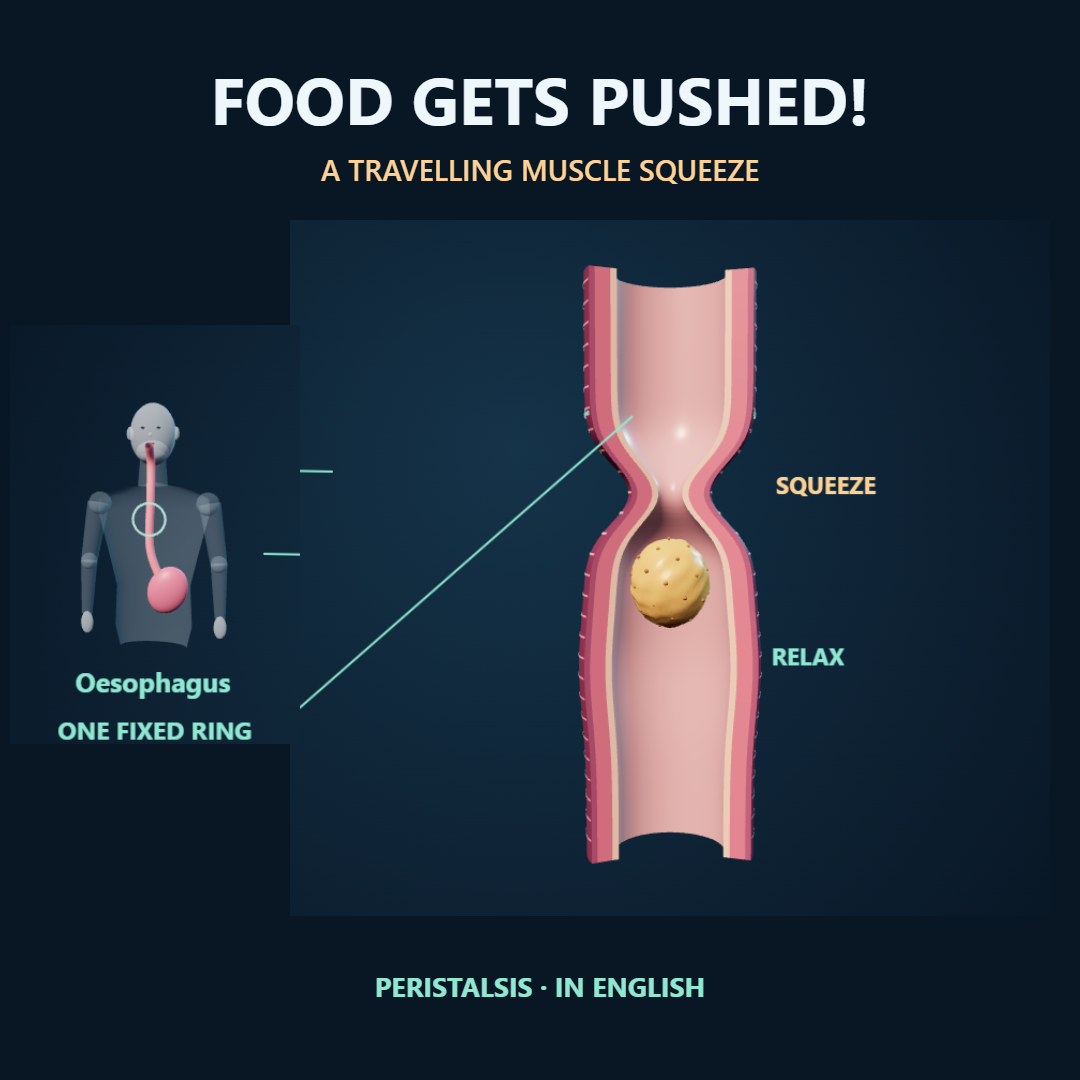 ▶ Tap to open the interactive model
Runs in its own frame, so it never slows the rest of the page. Tap Full screen for the best view, or rotate your phone to landscape.
Bile and Lipase — interactive 3D
Open larger view ↗Runs in its own frame, so it never slows the rest of the page. Tap Full screen for the best view, or rotate your phone to landscape.
2. Respiration — Important Points
Cellular respiration is the process in which food such as glucose is broken down to release energy. Do not confuse it with breathing, which is the physical movement of air into and out of the lungs.
NCERT-style pathway summary. “More energy” is used comparatively; exact ATP counts are not required here.
| Feature | Aerobic respiration | Anaerobic pathway |
|---|---|---|
| Oxygen | Required | Not required |
| Breakdown of glucose | More complete | Incomplete |
| Typical products | Carbon dioxide and water | Ethanol + carbon dioxide in yeast, or lactic acid in muscle cells when oxygen is insufficient |
| Energy released | More | Less |
Gas exchange in humans
Air reaches the alveoli of the lungs. Their large surface area, thin walls and rich blood supply support rapid diffusion. Oxygen diffuses into blood while carbon dioxide diffuses from blood into the alveolar air.
Transport of gases
Haemoglobin in red blood cells carries oxygen efficiently. Carbon dioxide is more soluble in water and is transported mainly in dissolved chemical forms in blood plasma.
Board-ready answer: Differentiate breathing and respiration.
Breathing is the physical process of inhalation and exhalation that brings air into the lungs and removes it. Cellular respiration is the biochemical breakdown of food in cells to release energy.
3. Transportation — Important Points
Multicellular organisms need transport systems because diffusion alone cannot move materials quickly enough over large distances.
Human circulatory system
The main components are the heart, blood and blood vessels. The heart maintains circulation by pumping blood through two linked circuits.
Pulmonary circulation heart → lungs → heart
Systemic circulation heart → body → heart
Why double circulation matters
In one complete cycle, blood passes through the heart twice. This helps keep oxygenated and deoxygenated blood separate and allows efficient delivery of oxygen to body tissues.
Double circulation — follow the blood, not a memorised picture
Pulmonary circuit: right side of heart → lungs → left side of heart. Systemic circuit: left side of heart → body → right side of heart.
Arteries, veins and capillaries
| Feature | Arteries | Veins | Capillaries |
|---|---|---|---|
| Direction | Away from heart | Towards heart | Connect small arteries and veins through tissues |
| Wall | Thick and elastic | Thinner than arteries | Very thin, one-cell thick |
| Pressure | Relatively high | Lower | Low enough for exchange |
| Valves | Generally absent along their length | Present in many veins to prevent backflow | Absent |
Transportation in plants
Xylem
Transports water and mineral salts mainly from roots to aerial parts. Root pressure and, especially in taller plants, transpiration pull contribute to upward movement.
Phloem
Transports soluble products of photosynthesis from source regions to parts that use or store them. This translocation requires energy.
Board-ready answer: What is double circulation?
Double circulation is the circulation in which blood passes through the heart twice during one complete cycle. The pulmonary circuit carries deoxygenated blood from the heart to the lungs and returns oxygenated blood to the heart. The systemic circuit carries oxygenated blood from the heart to the body and returns deoxygenated blood.
4. Excretion — Important Points
Excretion is the removal of metabolic wastes produced by the body. In humans, the kidneys remove nitrogenous wastes from blood and regulate the amount of water and dissolved substances in the body.
Urine formation — concept flowchart
This flowchart is deliberately conceptual rather than anatomical, so the process remains clear without an inaccurate nephron drawing.
Path of urine
Kidneys → ureters → urinary bladder → urethra
The kidneys form urine, ureters carry it to the bladder, the bladder stores it temporarily, and the urethra carries it out of the body.
Excretion in plants
Plants remove gaseous wastes by diffusion through stomata and other surfaces. Some wastes are stored in vacuoles, leaves or old xylem, or released as substances such as resins and gums. Excess water is removed mainly by transpiration.
Board-ready answer: How is urine formed?
Blood is filtered through the glomerulus into Bowman’s capsule. As the filtrate passes through the renal tubule, useful substances such as glucose, amino acids, salts and the required amount of water are selectively reabsorbed into the blood. The remaining fluid contains nitrogenous wastes and excess water and salts; it passes into collecting ducts and ultimately forms urine.
Do Not Mix These Up
| Pair | Key distinction |
|---|---|
| Breathing vs respiration | Breathing exchanges air with the environment; cellular respiration releases energy from food inside cells. |
| Xylem vs phloem | Xylem transports water and minerals mainly upward; phloem transports soluble food from source to sink and requires energy for translocation. |
| Artery vs vein | Arteries carry blood away from the heart; veins carry blood towards the heart. |
| Excretion vs egestion | Excretion removes metabolic wastes; egestion removes undigested food from the alimentary canal. |
Before You Leave: 8-Point Recall Checklist
Tick a point only if you can explain it without looking above. This is a quick recall tool, not a marks prediction.
0 of 8 recalled confidently.
8-question revision self-check
Two questions from each major area. Submit once to see your topic-wise result and what to revise next.
Your revision result
Choose Your Next Step
Full chapter notes
Use the detailed notes when you need first-time learning or a slower explanation before quick revision.
Open full Life Processes notes20-MCQ interactive quiz
Use Practice mode for instant explanations or Test mode for an exam-style attempt and topic-wise score.
Open the Life Processes quizCompetency-based practice
Apply the chapter through experiment-based, case-based, assertion–reason and scientific-reasoning questions.
Open competency questions
Pingback: Life Processes Class 10 Quiz — 20 MCQs with Answers - Pandey Sir BEST Classes