
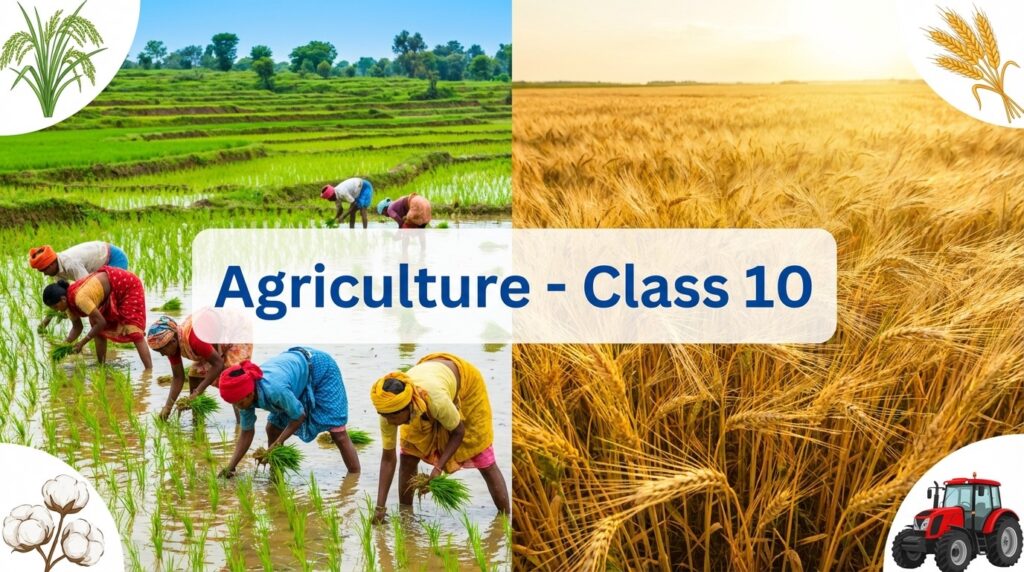
Agriculture Class 10 Notes PDF Free 2026 CBSE
Download FREE Agriculture Class 10 Notes PDF for CBSE 2026 board exams. Complete chapter coverage with types of farming, crops, and food security. Study now!
| S.No. | Important Point | Why It’s Important (Exam Relevance) |
|---|---|---|
| 1 | Agriculture employs 58% of India’s population – Despite contributing only 16% to GDP, it remains the primary livelihood source for majority Indians. | Frequently asked statistic in board exams (1-3 marks). Shows economic importance of agriculture. |
| 2 | Types of Farming: (a) Subsistence – for self-consumption, (b) Commercial – for market sale, (c) Plantation – single crop on large estates. | Common 3-5 mark question. Students must differentiate between these three types with examples. |
| 3 | Primitive Subsistence Farming (Slash and Burn) – Known as Jhumming in North-East, Milpa in Central America, and Ladang in Indonesia. | Map-based questions and 1-2 mark definitions frequently appear in exams. |
| 4 | Cropping Seasons: Kharif (June-September) – rice, cotton, maize; Rabi (October-March) – wheat, gram, mustard; Zayad (March-June) – watermelon, cucumber. | Most important concept for 3-5 mark questions. Must memorize season-wise crops. |
| 5 | Rice – Kharif crop requiring high temperature (25°C), high humidity, 100cm+ rainfall. Major producers: West Bengal, Punjab, Uttar Pradesh. | Staple crop questions appear in every exam. Know temperature, rainfall, and top 3 states. |
| 6 | Wheat – Rabi crop requiring 50-75cm rainfall, 10-15°C at sowing, 21-26°C at ripening. Major producers: Punjab, Haryana, Uttar Pradesh. | Second most important crop. Compare with rice for difference-based questions. |
| 7 | Millets (Jowar, Bajra, Ragi) – Known as coarse grains, require less rainfall, grow on less fertile soils, resist droughts. | Often asked as 1-3 mark questions highlighting their importance in dry regions. |
| 8 | Major Cash Crops: Sugarcane (tropical, 2nd largest producer globally), Cotton (black soil/regur), Jute (golden fiber, West Bengal & Assam), Tea (plantation crop, Assam). | 5-mark question asking characteristics, areas, and importance of any two cash crops. |
| 9 | Green Revolution (1960s-70s) – Increased wheat and rice production through HYV seeds, irrigation, fertilizers, and pesticides. Mainly benefited Punjab, Haryana, and Western UP. | 3-5 mark long answer question on causes, features, and impacts of Green Revolution. |
| 10 | Food Security – Availability, accessibility, and affordability of food to all at all times. Ensured through Public Distribution System (PDS) and buffer stock. | Contemporary issue-based question worth 3-5 marks in board exams. |
| 11 | Problems of Indian Agriculture: Small land holdings, dependence on monsoons, lack of mechanization, inadequate storage, poor marketing facilities. | Common 5-mark question asking challenges and solutions in Indian agriculture. |
| 12 | Impact of Globalization: Increased export opportunities but also farmer distress due to price fluctuations, competition, and withdrawal of government support. | HOTS question connecting agriculture with globalization (3-5 marks). |
| 13 | Horticulture Crops: India is largest producer of fruits and vegetables. Major products include mango, banana, coconut, cashew, spices. | 1-2 mark questions on India’s position in global horticulture production. |
| 14 | Technological Reforms Needed: Crop insurance, establishment of Grameen banks, cooperative societies, regulated markets, and minimum support price (MSP). | Policy-based 3-mark question on government initiatives for agricultural development. |
| 15 | Sustainable Agriculture Practices: Organic farming, mixed farming, crop rotation to maintain soil fertility and reduce chemical dependence. | Modern exam trend focuses on sustainability – expect 3-5 mark questions. |
FREQUENTLY ASKED QUESTIONS (FAQs)
1. What is Agriculture? Why is it important for India?
Agriculture is the science and practice of cultivating crops and rearing animals for food, fiber, and other products. It is crucial for India as it employs 58% of the population and provides livelihood to millions. Despite contributing 16% to GDP, it ensures food security, supplies raw materials to industries, and forms the backbone of rural economy.
2. What are the three types of farming in India?
The three main types are:
- Subsistence Farming: Growing crops primarily for family consumption (primitive and intensive subsistence)
- Commercial Farming: Large-scale production for market sale to earn profit
- Plantation Farming: Single cash crop cultivation on large estates (tea, coffee, rubber, banana)
Each type differs in scale, investment, technology use, and market orientation.
3. What is the difference between Kharif and Rabi crops?
| Aspect | Kharif Crops | Rabi Crops |
|---|---|---|
| Season | Sown in June-July, harvested September-October | Sown in October-November, harvested March-April |
| Climate | Require hot and humid conditions with high rainfall | Require warm sowing conditions and cold growing season |
| Rainfall | 100+ cm rainfall needed | 50-75 cm rainfall sufficient |
| Examples | Rice, cotton, maize, jowar, bajra, groundnut | Wheat, gram, peas, mustard, barley |
| Dependence | Monsoon dependent | Irrigation dependent |
4. What are the geographical conditions required for growing rice and wheat?
Rice Requirements:
- Temperature: 25°C or above
- Rainfall: 100 cm or more
- Soil: Deep clayey and loamy soil
- Water: Abundant water and high humidity
- Major States: West Bengal, Uttar Pradesh, Punjab, Andhra Pradesh, Tamil Nadu
Wheat Requirements:
- Temperature: 10-15°C (sowing), 21-26°C (ripening)
- Rainfall: 50-75 cm
- Soil: Well-drained fertile alluvial soil
- Climate: Cool growing season, bright sunshine at harvest
- Major States: Punjab, Haryana, Uttar Pradesh, Madhya Pradesh
5. What is Green Revolution? What are its impacts?
Green Revolution refers to the dramatic increase in agricultural production (especially wheat and rice) during the 1960s-1970s through the introduction of High Yielding Variety (HYV) seeds, chemical fertilizers, pesticides, and improved irrigation.
Positive Impacts:
- India became self-sufficient in food grains
- Increased production and productivity
- Improved farmers’ income in Punjab, Haryana, Western UP
Negative Impacts:
- Limited to wheat and rice only
- Regional imbalance (benefited only some states)
- Environmental degradation due to excessive chemical use
- Increased gap between rich and poor farmers
6. What are the major problems faced by Indian farmers?
Indian agriculture faces several challenges:
- Small and fragmented land holdings limiting mechanization
- Dependence on uncertain monsoons causing crop failures
- Lack of modern technology and equipment
- Inadequate credit and insurance facilities
- Poor storage and transport infrastructure leading to wastage
- Fluctuating market prices and lack of assured income
- Soil degradation due to excessive chemical use
- Farmer indebtedness and distress due to crop failure
7. Which soil is best for cotton cultivation and why?
Cotton grows best in black soil (Regur soil) because:
- Black soil has high moisture retention capacity
- It is rich in calcium, potassium, and magnesium
- It develops deep cracks during dry season, allowing aeration
- Cotton requires deep soil and warm climate (25°C+)
- Black soil regions receive moderate rainfall (50-100 cm) ideal for cotton
Major cotton-producing states with black soil: Maharashtra, Gujarat, Madhya Pradesh, Karnataka, Andhra Pradesh.
8. What is Jhumming? Where is it practiced?
Jhumming is a primitive subsistence farming practice, also known as slash and burn agriculture. Farmers clear forest patches by cutting and burning trees, cultivate crops for 2-3 years until soil fertility declines, then move to new patches.
Other names in different regions:
- Milpa – Mexico and Central America
- Ladang – Indonesia and Malaysia
- Roca – Brazil
- Bewar – Madhya Pradesh
- Dahiya – Himachal Pradesh
This practice is environmentally harmful as it causes deforestation and soil erosion.
9. What is Food Security? How is it ensured in India?
Food Security means availability, accessibility, and affordability of food to all people at all times. A country is food secure when every citizen can access adequate nutritious food without hunger or fear of starvation.
Food Security is ensured through:
- Buffer Stock: Government maintains stock of food grains for emergencies
- Public Distribution System (PDS): Ration shops provide subsidized food to poor
- Minimum Support Price (MSP): Guaranteed price to protect farmers from losses
- Food Corporation of India (FCI): Procures, stores, and distributes food grains
- Mid-Day Meal Scheme: Ensures nutrition for school children.
10. What is the difference between food crops and cash crops?
| Food Crops | Cash Crops |
|---|---|
| Grown for direct consumption as food | Grown for commercial sale in market |
| Examples: Rice, wheat, millets, pulses | Examples: Sugarcane, cotton, jute, tea, coffee |
| Meet nutritional needs of population | Earn income and foreign exchange |
| Cultivated for subsistence | Cultivated for profit |
| Usually consumed locally | Exported or sold to industries |
11. Why is Assam the leading producer of tea in India?
Assam produces maximum tea in India because:
- Climate: Tropical climate with warm and humid conditions ideal for tea
- Rainfall: Heavy rainfall throughout the year (150-200 cm)
- Soil: Deep, fertile alluvial soil with good drainage
- Labor: Abundant cheap labor for tea plucking
- Topography: Gentle slopes in Brahmaputra valley suitable for tea gardens
- British Legacy: Tea plantations established during colonial period
Assam accounts for about 50% of India’s total tea production.
12. What are millets? Why are they called coarse grains?
Millets include Jowar (Sorghum), Bajra (Pearl Millet), and Ragi (Finger Millet). They are called coarse grains because they have:
- Rough texture and lower palatability compared to rice and wheat
- Lower market value
- Consumed mainly by economically weaker sections
Why millets are important:
- Grow on less fertile and sandy soils
- Require minimal water (drought resistant)
- Can be cultivated in dry regions where rice/wheat cannot grow
- High nutritional value (rich in iron, calcium, fiber)
- Called “Nutri Cereals” – important for food security
13. How does irrigation help Indian agriculture?
Irrigation is crucial for Indian agriculture because:
- Monsoon uncertainty: Monsoons are erratic and unevenly distributed
- Multiple cropping: Enables cultivation of 2-3 crops per year
- Water for dry regions: Makes cultivation possible in low rainfall areas
- Higher productivity: Ensures water supply during critical crop stages
- Rabi cultivation: Makes winter crop cultivation possible
Major irrigation sources: Canals, wells, tube wells, tanks, and modern methods like drip and sprinkler irrigation help conserve water.Agriculture-pandey-sir-best-classes.pdf
14. What is the importance of sugarcane cultivation in India?
Sugarcane is an important cash crop because:
- India is the 2nd largest producer of sugarcane globally (after Brazil)
- Provides raw material to sugar industry
- Generates employment in rural areas
- By-products used: molasses (for alcohol), bagasse (fuel and paper)
- Thrives in tropical climate with 75-100 cm rainfall
- Major producers: Uttar Pradesh, Maharashtra, Karnataka, Tamil Nadu
Sugarcane cultivation faces challenges like water-intensive nature and price fluctuations.
15. What is organic farming? Why is it promoted?
Organic farming is cultivation without using chemical fertilizers and pesticides. It relies on:
- Natural manure (compost, cow dung, green manure)
- Biological pest control
- Crop rotation and mixed cropping
- Use of bio-fertilizers
Benefits of organic farming:
- Maintains soil fertility naturally
- Produces chemical-free healthy food
- Environmentally sustainable
- Prevents soil and water pollution
- Reduces farmer’s input cost
- Fetches higher market price
Government promotes organic farming for sustainable agriculture and farmer welfare.